Founder advisory
If the business stops when you step away, you have not scaled. You have gotten busier.
Why can’t my business run without me? Because authority never moved when the work did.
You delegated tasks but kept every decision, so the team learned to wait for you. The structure has one authorized decision maker, and you are it. Discipline and hiring are not the constraint.

How you know
Founder dependency looks like this.
The decision bottleneck
Every call with risk attached waits for you, so the team’s speed is your availability.
Revenue tied to the founder
Deals close because you touched them. Pipeline slows the week you step away.
No real accountability layer
Roles exist on paper, but no one owns an outcome you have not personally approved.
A team that waits instead of owns
Checking with you is the low-risk option, so checking with you becomes the culture.
In the companies I have worked in, those four share a root: authority that never moved.
The order that works
The F.R.E.E.D. framework, applied to your company.
In the engagements I have run, founder dependency and the people problem turn out to be the same problem. One structure creates both, and one change addresses both: authority and accountability move together, into named seats, held by systems.
In my experience the step most often skipped is the second one, and without it the first rarely holds.
- 01
Find
Locate every decision that still routes through you. Most founders are surprised by the length of the list.
You get a written map of every place the business stops when you do.
- 02
Redistribute
Move authority and accountability together, so the person who owns the outcome can make the call without asking.
Decisions get named owners, so the team stops queuing at your door.
- 03
Engineer
Build the systems that hold the work when you are not watching.
The standard lives in the system, not in your memory.
- 04
Embed
Make the new way survive contact with a busy quarter.
The new way survives the week you are not watching.
- 05
Develop
Grow leaders who carry it forward after you stop pushing.
Someone else can carry it, and does.
The standard
What done looks like
You can leave for thirty days with no contact and the numbers hold. Decisions you have handed over stay handed over. The logic behind your pricing, your hiring, and your largest relationships is written down and being used by someone other than you.
That is the standard. It is testable, and you already know today whether you would pass it.
From the work
One founder built a business successful enough to own show horses. He pays someone else to show them.
The business cannot run for a weekend without him. He bought the symbol of the life he wanted, then watched someone else live it. That is what founder dependency costs, and it never shows up on the profit and loss statement.
The diagnosis is the easy part. What changes anything is whether the business can hold a decision the founder did not make.
The cost is easy to see once someone points at it. Removing it has an order.
Client work
The method in a live engagement.
Varsity Orthopedics, where Dr. Quatro Ott approved scheduling, hiring, and every exception. The engagement applies F.R.E.E.D., and the schedule, the standard and the escalation path are now documented and in use by the team. The engagement is ongoing and outcomes are still being tracked.
Read the full engagement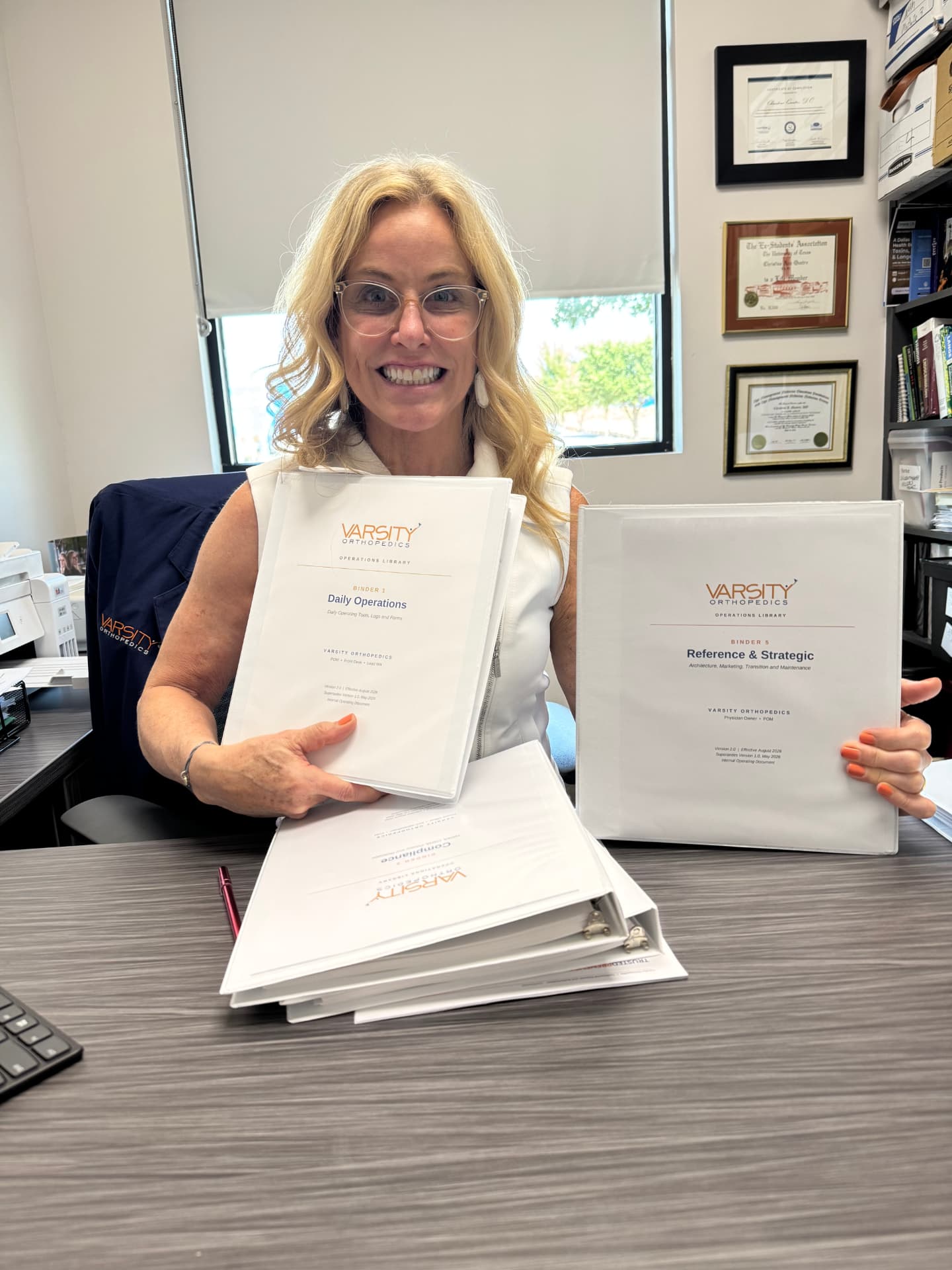
There are no excuses anymore.

Positioning and offer structure
Steady Bridge Consulting
A consulting founder five months in, running three offer ladders that contradicted each other, with no single answer to what he did. The work found the word he had been writing without noticing and built the structure around it.
The operating seat
Written from inside a working company.
I am the current CEO of BNN Services, and I still run it. This approach comes from that seat as well as from client work.
Common questions
- Why can’t my business run without me?
- Because authority never moved when the work did. You delegated tasks but kept every decision, so the team learned to wait for you.
- What is founder dependency?
- Founder dependency is a structure where revenue, decisions, and standards all route through one person. It tends to cap growth at the founder’s capacity and can lower what the company is worth.
- How does the F.R.E.E.D. framework reduce founder dependency?
- F.R.E.E.D. finds every dependency on the founder, redistributes authority and accountability together, engineers the systems that hold the work, embeds the new way inside the team, and develops leaders who carry it forward.
- My team has heard this before. Why would it stick this time?
- In the work I have done, change holds better when authority moves with accountability. Handing people responsibility without the power to decide is a common reason change fails.
- Do you do the work, or advise while my team does it?
- Both, in that order. The systems get designed with you, then embedded with the people who will run them. A system nobody owns is a document, not a change.
Deciding what fits used to run on anxiety. Now it runs on the framework.
Contact
Advisory work, writing and public appearances.
For inquiries, write to mricci@themadelinericci.com or use the contact page.