Founder advisory

You built a business that can’t run without you. I built one that can.

Founder advisory and AI operating leverage for established founders whose companies still route through one person.

Led by a sitting CEO of an eight-figure firm, not a former operator turned coach.

One conversation. No pitch. You leave with clarity either way.

Most founders think the fix is delegating more. It is almost the opposite.

Madeline Ricci, operator and strategist, in a cream blazer against a charcoal backdrop

The test

Could you leave for thirty days with no contact?

Most founders answer that in under a second, and they do not like the answer. The useful question is the next one: which part breaks first.

Find out what breaks first

Twelve minutes. No call required.

The misdiagnosis

The founder bottleneck is not a time problem. It is how the business is built.

Revenue moves when you move. Decisions sit in your inbox waiting for a yes. Your best people ask instead of deciding, because asking has never once been the wrong answer. Growth is capped by your calendar. That is a profitable trap, and it gets more expensive the bigger it gets.

There is a reason it has not resolved, and it is rarely the reason founders reach for.

BUILT AROUND YOU

Built around you: every line terminates at the founder at the centre.HIRINGPRICINGQUALITYVENDORSCLIENTSSALESYOUEvery decision terminates at one person.

BUILT BEYOND YOU

Built beyond you: the same work distributed across three named owners, with the founder no longer the only termination point.HIRINGPRICINGQUALITYVENDORSCLIENTSSALESOPSREVENUEDELIVERYYOUThe work sits with named owners.
Left: every line terminates at the founder. Right: the same work distributed across named owners.

The real problem

Why delegating more has not fixed it

Most founders answer the bottleneck by handing out more tasks. The tasks move. The decisions do not. So the team learns to wait, and you conclude that nobody is ready.

Authority and accountability have to move together or neither one moves. That single distinction is the difference between a business that runs and a business that reports.

Read: delegation fails when authority and accountability do not move together

Which means the fix has an order, and most people run it backwards.

Three places it breaks

Three levers, one outcome: a company that holds without you.

Most engagements start with the first. The other two come in when the business is ready for them.

  • Founder advisory

    Reduce founder dependency and install the leadership systems and accountability that let the business run without you.

    The company keeps its standard on the days you are not in it.

    Explore founder advisory
  • AI consulting

    Map where AI creates real operating leverage in your business, and where it is only noise.

    You stop paying for AI that runs a broken process faster.

    Explore AI consulting
  • Brand and growth strategy

    Sharpen positioning and growth so the company is worth more and scales cleaner.

    The company is worth more to a buyer and easier to sell to a customer.

    See the brand and growth engagements

All three depend on the same sequence.

There are five places founder dependency hides. Most founders can name two.

The order that works

FREED: how a business gets built beyond its founder.

  1. 01

    Find

    Locate every decision that still routes through you. Most founders are surprised by the length of the list.

    You get a written map of every place the business stops when you do.

  2. 02

    Redistribute

    Move authority and accountability together, so the person who owns the outcome can make the call without asking.

    Decisions get named owners, so the team stops queuing at your door.

  3. 03

    Engineer

    Build the systems that hold the work when you are not watching.

    The standard lives in the system, not in your memory.

  4. 04

    Embed

    Make the new way survive contact with a busy quarter.

    The new way survives the week you are not watching.

  5. 05

    Develop

    Grow leaders who carry it forward after you stop pushing.

    Someone else can carry it, and does.

Founder dependency and the people problem are the same problem. FREED solves both.

Whether that sequence holds depends entirely on who is running it.

Client work

What it looks like on the other side.

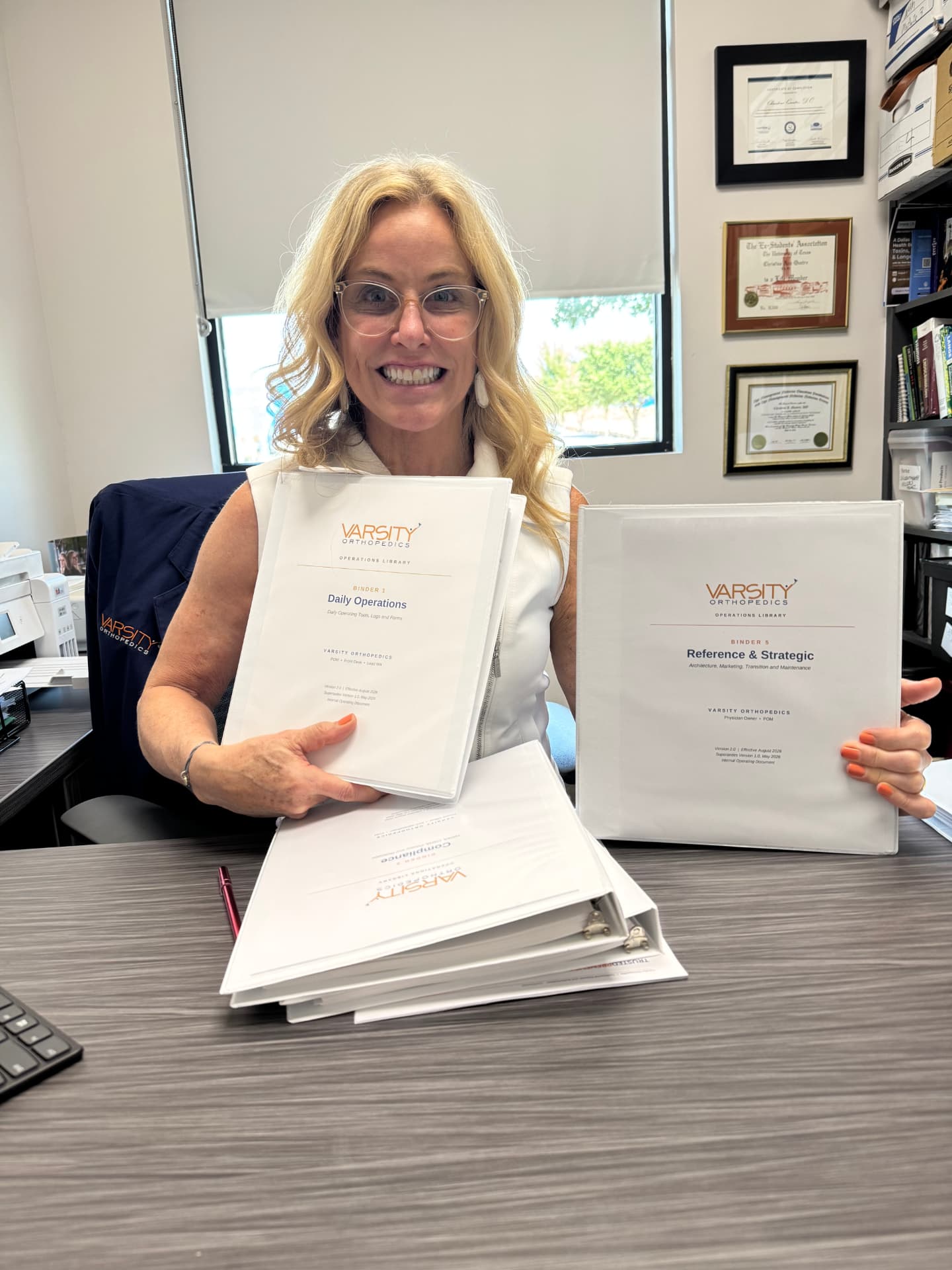
Varsity Orthopedics, where Dr. Quatro Ott approved scheduling, hiring, and every exception. Growth stalled at the limit of one calendar.

Hiring came off her plate as a process and came back to her as a choice. The schedule, the standard, and the escalation path are documented and in use by the team.

Dr. Quatro Ott at her desk holding two binders from the Varsity Orthopedics operations library
The Varsity Orthopedics operations library, version 2.0, in the practice

There are no excuses anymore.

Dr. Quatro Ott, Varsity Orthopedics

Systems delivered August 2026. Measured outcomes follow the first full quarter.

Read the full engagement

Whose advice this is

Most advisors sold their business, then started coaching. I never left the operator’s seat.

I am the current CEO of BNN Services, an eight-figure national services firm I started in 2008 after an 18-year corporate career ended in a layoff. I built it during a recession, with no advertising and no social audience.

Every recommendation gets tested in a company I still run.

That seat started in the worst possible year to start anything.

What is verifiable

A national network of 40,000+ agents. 18 years of corporate leadership before entrepreneurship.

See the full record

The first one I fixed

The first founder-dependent business I fixed was mine.

In 2008 Madeline was laid off after an 18-year corporate career and started BNN Services in a recession, without advertising or an audience. She built it into an eight-figure national services firm with a network of 40,000+ trusted agents.

The proof is what her week looks like. She still leads BNN Services as CEO while advising founders, co-hosting a podcast, and running a consulting firm.

That is what Build Beyond You means.

Read the full BNN story

What changes

What it looks like when it holds

You take a two-week trip and the numbers do not move. Your leadership team brings you decisions that are already made, for visibility rather than permission. A buyer looks at the business and sees a company, not a person with revenue attached.

You stay because you want to, not because it collapses if you leave.

“AI does not fix operational dysfunction. It accelerates whatever operating system you already have.”

Madeline Ricci

Picture the business five years from now, unchanged. Count what that costs. Not in dollars. In moments you do not get back.

Fit

Who this is for.

Who this is for

Founders running $2M to $25M with a team of 8 to 80, where the company still routes through one person. Usually because growth stalled at the edge of your calendar, or because someone told you the business is not sellable the way it is built.

Who this is not for

Early companies still looking for their first customers, and founders who want encouragement rather than a change to how the company runs.

Before you book

What the conversation is.

What it is

Thirty minutes. You describe where the business waits for you. I tell you what I see, and what I would change first.

What it is not

A pitch, or a proposal in disguise. If it is not a fit, I will say so on the call.

What happens after

If we both want to keep going, you get a written scope built around what the business needs. Engagements run in months, not sessions, and they end when the business holds without you.

What you leave with

  • A read on where the business waits for you, named specifically, not generally.
  • The one change I would make first, and why that one.
  • An honest answer on whether this is worth continuing.

Before you book

The questions founders ask first.

Will this work for a business like mine?
It works where the company already has revenue and a team and the founder is the constraint. It does not work where the problem is that nobody is buying yet. If you are not sure which one you are, that is what the conversation is for.
How long does an engagement run?
Months, not sessions. Founder dependency was built over years and it comes out in stages. The work ends when the business holds without you, not when a package runs out.
Do you do the work, or advise while my team does it?
Both, in that order. The systems get designed with you, then embedded with the people who will run them. A system nobody owns is a document, not a change.
My team has heard this before. Why would it stick this time?
Because authority moves with accountability instead of behind it. Most change fails when people are handed responsibility without the power to decide. That is a structural fix, not a motivation problem.
You still run an eight-figure company. How available are you?
That is the point. I advise from inside the work, not from memory of it, and I take a small number of engagements so that stays true. Availability is part of what we cover on the call.
What if I am not ready to start?
Then do not start. You will still leave knowing where the business waits for you, which is useful whether or not we work together.

Next step

Let’s find out what your business does without you.

One conversation. We look at where the business waits for you, and what it would take for it to stop. I work with founders worldwide running 2M to 25M businesses.

Talk with Madeline

One conversation. No pitch. You leave with clarity either way.

Find out what breaks first

Twelve minutes. No call required.

Notes from the work

Written while running the company.